
YOU ARE ABOUT TO LEAVE FARXIGA.COM
Please verify that you are a US Healthcare Professional. This information is intended for US Healthcare Professionals only. Are you a US Healthcare Professional?


 CHRONIC KIDNEY DISEASE
For adults with CKD, FARXIGA is also proven to help:
-

Reduce the risk of
kidney failure, which
can lead to dialysis -

Slow the
progression
of CKD -

Keep you living life by
reducing the risk of
cardiovascular death
7 other ways to help protect your kidneys
Now that you've learned about FARXIGA for CKD, here are some additional things you can do for your kidney health:
Now that you've learned about FARXIGA for CKD, here are some additional things you can do for your kidney health:
-

Track your kidney numbers—get your eGFR* and UACR† tests at least once a year and talk to your doctor about your kidney numbers when you get your lab work done. Click for more information on kidney numbers
-

Control your blood pressure and/or blood sugar
-

Avoid nonsteroidal anti-inflammatory drugs (NSAIDs) like ibuprofen and naproxen
-

Stay active and aim for a healthy weight
-

Follow a diet that is low in sodium, saturated fat, and sugar
-

Quit smoking
-

Discuss any vitamins, minerals, herbs, or weight loss or body building supplements with your doctor before taking them. They can damage your kidneys!
*eGFR stands for “estimated glomerular filtration rate.” eGFR is measured in mL/min/1.73 m2.
†UACR stands for “urine albumin-to-creatinine ratio.” UACR is measured in mg/g.

IMPORTANT SAFETY INFORMATION
Who should not take FARXIGA?
Do not take FARXIGA if you are allergic to dapagliflozin or any of the ingredients in FARXIGA. Symptoms of a serious allergic reaction may include skin rash, raised red patches on your skin (hives), swelling of the face, lips, tongue, and throat that may cause difficulty in breathing or swallowing. If you have any of these symptoms, stop taking FARXIGA and contact your healthcare provider or go to the nearest hospital emergency room right away.
What are the possible side effects of FARXIGA?
FARXIGA may cause serious side effects including:
- Ketoacidosis. FARXIGA can cause ketoacidosis, a serious condition which may require hospitalization and lead to death. People with type 1 diabetes, type 2 diabetes, or pancreas problems have a high risk of getting ketoacidosis. Signs and symptoms may include nausea, tiredness, vomiting, trouble breathing, abdominal pain, and ketones in your urine or blood. If you get any of these symptoms, stop taking FARXIGA and call your healthcare provider right away. If possible, check for ketones in your urine or blood, even if your blood sugar is less than 250 mg/dL
- Dehydration (the loss of body water and salt), which may cause you to feel dizzy, faint, lightheaded, or weak, especially when you stand up (orthostatic hypotension). There have been reports of sudden kidney injury in people with type 2 diabetes who are taking FARXIGA. You may be at a higher risk of dehydration if you take medicines to lower your blood pressure, including water pills (diuretics); are age 65 or older; are on a low salt diet, or have kidney problems. Talk to your healthcare provider about what you can do to prevent dehydration including how much fluid you should drink on a daily basis. Call your healthcare provider right away if you reduce the amount of food or liquid you drink, or if you experience vomiting or diarrhea
- Genital and urinary tract infections. FARXIGA can cause serious infections in your genital area or urinary tract that could require hospitalization. A rare but serious bacterial infection called necrotizing fasciitis can cause damage to the tissue under the skin in the area between and around the anus and genitals (perineum). This infection may require hospitalization, multiple surgeries, and could lead to death. Seek medical attention immediately if you have a fever or you are feeling very weak, tired or uncomfortable (malaise), and you develop pain or tenderness, swelling, or redness of skin (erythema) in the area between and around your anus and genitalsAlso tell your healthcare provider if you have any of these signs or symptoms of infection:
- urinary tract infection: burning feeling when you urinate, need to urinate often or right away, pain in the lower part of your stomach (pelvis), blood in your urine. You may also have a fever, back pain, nausea, or vomiting
- vaginal yeast infection: vaginal odor, white or yellowish vaginal discharge (may be lumpy or look like cottage cheese), vaginal itching
- yeast infection of the skin around the penis: swelling of an uncircumcised penis may make it difficult to pull back the skin around the tip of your penis. Other symptoms include: redness, itching, or swelling of the penis, bad smelling discharge from the penis, rash on the penis, and/or pain in the skin around the penis. Talk to your healthcare provider about what to do if you get symptoms of a yeast infection. They may suggest you use an over-the-counter antifungal medicine. Contact your healthcare provider right away if your symptoms do not improve after using an over-the-counter antifungal medicine
- Low blood sugar (hypoglycemia) can occur if you take FARXIGA with another medicine that can cause low blood sugar, such as sulfonylureas or insulin. Symptoms of low blood sugar include shaking, sweating, fast heartbeat, dizziness, hunger, headache, and irritability. Follow your healthcare provider's instructions for treating low blood sugar
The most common side effects of FARXIGA include yeast infections of the vagina or penis; stuffy or runny nose and sore throat; and changes in urination, including urgent need to urinate more often, in larger amounts, or at night.
What should I tell my healthcare provider before taking FARXIGA?
Before you take FARXIGA, tell your healthcare provider:
- all of your medical conditions, including problems with your liver or pancreas
- if you have had diabetic ketoacidosis
- if you have type 1 diabetes, decrease in your insulin dose, serious infection, history of infection of the vagina or penis, history of urinary tract infections, or problems with urination
- if you are on a low sodium diet, going to have surgery, eating less or change in diet, dehydrated, or binge drink
- if you are pregnant, or plan to become pregnant. FARXIGA may harm your unborn baby
- if you are breastfeeding, or plan to breastfeed. It is unknown if FARXIGA passes into your breast milk
- about all the medicines you take, including prescription and nonprescription medicines, vitamins, and herbal supplements
APPROVED USES FOR FARXIGA
What is FARXIGA?
FARXIGA is a prescription medicine used to:
- improve blood sugar control along with diet and exercise in adults and children who are 10 years of age and older with type 2 diabetes
- reduce the risk of hospitalization for heart failure in adults with type 2 diabetes and known cardiovascular disease or multiple cardiovascular risk factors
- reduce the risk of cardiovascular death, hospitalization for heart failure, and urgent heart failure visit in adults with heart failure, when the heart cannot pump enough blood to the rest of your body
- reduce the risk of further worsening of your kidney disease, end-stage kidney disease, death due to cardiovascular disease, and hospitalization for heart failure in adults with chronic kidney disease
FARXIGA is not for use to improve blood sugar (glucose) control in people with type 1 diabetes.
FARXIGA is not for use to improve blood sugar (glucose) control in people with type 2 diabetes who have moderate to severe kidney problems, because it may not work.
FARXIGA is not for people with certain genetic forms of polycystic kidney disease, or who are taking or have recently received immunosuppressive therapy to treat kidney disease. FARXIGA is not expected to work if you have these conditions.
Please see Prescribing Information and Medication Guide for FARXIGA.
You may report side effects related to AstraZeneca products  .
.
ELIGIBILITY AND TERMS OF USE
ELIGIBILITY: You may be eligible for this offer if you are insured by commercial insurance and your insurance does not cover the full cost of your prescription, or you are not insured and are responsible for the cost of your prescriptions. Patients who are enrolled in a state or federally funded prescription insurance program are not eligible for this offer. This includes patients enrolled in Medicare Part D, Medicaid, Medigap, Veterans Affairs (VA), Department of Defense (DOD) programs or TriCare, and patients who are Medicare eligible and enrolled in an employer-sponsored group waiver health plan or government-subsidized prescription drug benefit program for retirees. If you are enrolled in a state or federally funded prescription insurance program, you may not use this savings card even if you elect to be processed as an uninsured (cash-paying) patient. This offer is not insurance, is restricted to residents of the United States and Puerto Rico, and to patients over 18 years of age.
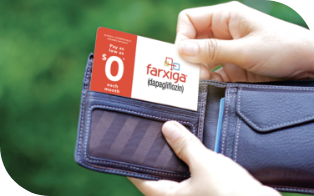
TERMS OF USE: Eligible commercially insured patients with a valid prescription for a FARXIGA® (dapagliflozin) Branded Family product who present this savings card at participating pharmacies will pay as low as $0 per 30-day supply subject to a maximum savings of $175 per 30-day supply. If you pay cash for your prescription, AstraZeneca will pay up to the first $150, and you will be responsible for any remaining balance, for each monthly prescription. Other restrictions may apply. Patient is responsible for applicable taxes, if any. Non-transferable, limited to one per person, cannot be combined with any other offer. Void where prohibited by law, taxed or restricted. Patients, pharmacists, and prescribers cannot seek reimbursement from health insurance or any third party for any part of the benefit received by the patient through this offer. AstraZeneca reserves the right to rescind, revoke, or amend this offer, eligibility and terms of use at any time without notice. This offer is not conditioned on any past, present or future purchase, including refills. Offer must be presented along with a valid prescription at the time of purchase. If you have any questions regarding this offer, please call 1-800-236-9933.
BY USING THIS CARD, YOU AND YOUR PHARMACIST UNDERSTAND AND AGREE TO COMPLY WITH THESE ELIGIBILITY REQUIREMENTS AND TERMS OF USE.
WHAT HAPPENS WHEN YOU PROVIDE YOUR PERSONAL INFORMATION
AstraZeneca respects your personal health information. The information you provide may be used to send you health-related materials and to develop products, services, and programs. Third parties working on behalf of AstraZeneca may receive information that includes the date that you filled the prescription, the quantity of medication dispensed by your pharmacist, and your savings under the Program. AstraZeneca, or third parties working on our behalf, will not sell or rent personal health information. If in the future you no longer want to receive these materials, please call 1-844-798-3617.
Please visit www.azprivacynotice.com to review our Privacy Notice.